Content
March 23, 2026
7 min read
Sive Buckley
Let’s just say it plainly: social media has changed, and a lot of brands are still posting like it’s 2019.
You can feel it in the content. It’s polished but empty. “Value-packed” but forgettable. Trendy but irrelevant. And it’s not because teams aren’t trying. It’s because the game has shifted from:
Who follows you?
to
Who cares enough to stop?
The algorithm doesn’t care how pretty your grid is. It cares whether your content creates a reaction strong enough to interrupt someone’s scrolling trance. Attention is the currency now, and most brands are broke.
So here’s the real shift in social right now, and what it means for content teams who want to win.
The feed isn’t built around followers anymore
Followers still matter. They’re just not the distribution engine they used to be.
The platforms have made a clear decision: instead of showing people posts based on who they follow, they’re showing people posts based on what their behaviour suggests they’ll watch.
That’s why your content might be shown to people who have never heard of you. It’s why reach can be up while conversions feel inconsistent. It’s why a creator with a phone and a point of view can outperform a brand with a studio shoot and a perfect grid.
The algorithm is asking a ruthless question: will this hold attention?
Not is this aesthetically pleasing. Not is this aligned to brand guidelines. Not did this go through five rounds of approvals.
Attention is the currency now, and most brands are spending it like it’s unlimited.
The algorithm isn’t mysterious. It’s behavioural.
People love talking about the algorithm like it’s a mystical force. It’s not. It’s a machine reading human behaviour at scale.
Right now, the strongest signals aren’t what most brands optimise for.
Watch time and dwell time matter more than likes. If someone stops and stays, the platform notices. If they scroll past, your post disappears quietly.
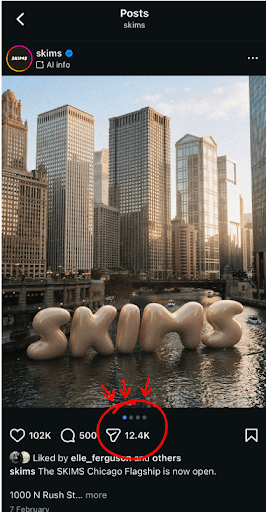
Saves and shares matter more than vanity metrics. A save means this is useful enough to come back to. A share means this makes me look smart, funny or interesting to someone else.
Real comments matter. Real questions, disagreement, people adding their own take, tagging someone who needs to see it. That kind of depth is what the platforms reward.
So if your content strategy is still built around posting consistently, you’ve built a schedule, not a growth engine.
Why generic tip content is dying
Everyone is tired. Your audience has been force-fed the same advice in different fonts for years.
The problem isn’t educational content. Education still performs. The problem is surface-level education that anyone could have written in five minutes.
If your post can be replaced by a template or a stock carousel, it’s not thought leadership. It’s filler.
What performs now is content that does at least one of three things.
- It has a point of view. It takes a stance. It risks being disliked. It says this is what we believe and here’s why. People don’t share neutral.
- It shows something real. Behind-the-scenes. A decision. A process. A mistake. Something that proves there are humans behind the brand and they actually know what they’re doing.
- It explains the why behind the outcome. Not just what to do, but how it works. The mechanics. The psychology. The trade-offs. The part everyone skips because it’s harder to write.
If your content doesn’t contain thinking, it will be treated like wallpaper.
What content is winning right now and why
If you want the simplest way to understand where content is going, it’s this: platforms are rewarding content that feels like it came from someone who actually knows something.
Not someone trying to sell. Not someone trying to be liked by everyone. Someone with a sharp brain and enough confidence to use it in public.
Here are three content lanes we’re leaning into heavily because they align with how distribution works today.

Show-your-thinking content
This is the fastest trust builder and the most underused content type in the market.
It looks like:
- why we didn’t follow that trend and what we did instead
- what failed, what we learned, and what changed because of it
- how we decide what gets posted and what gets cut
- why a creative concept worked, and why the obvious version wouldn’t
People don’t just buy services. They buy perspective. Showing your thinking sells your expertise without the hard sell.
Narrative-first content
Hooks aren’t gimmicks. They’re basic manners.
You’re competing with everything else on a person’s screen, including their group chat, their dopamine addiction, and whatever chaos the algorithm is serving them today. Your opening line is the toll gate.
Narrative-first content has structure. There’s tension, then payoff. There’s a problem, then a shift, then a solution. There’s a myth, then a reality check, then a takeaway.
If your post starts with Happy Monday, you’ve already lost. No one is emotionally invested in your Monday.
Proof-based content
This is where most brands get shy, because proof takes effort and confidence.
Proof isn’t just testimonials. Proof is showing the receipts. It’s what changed and why it changed. It’s a before-and-after with context. It’s the strategy logic that shows you’re not guessing. It’s the behind-the-scenes of the work.
If you want premium clients, your content needs to feel premium. Premium is confidence, specificity, and evidence.
The biggest lie brands believe
Most brands think the answer is more content.
It’s not. It’s better content.
You don’t need to flood the feed. You need to publish with intent, with a clear point of view, and with something worth saving or sharing.
A strong month can be a mix. Some brands will post daily and do it brilliantly. Others will post fewer times and make each piece hit harder. The point isn’t a magic number. The point is whether each post earns attention, builds trust, and moves the brand forward.
The standard we hold ourselves to
At Social St., we’re not interested in content that exists just to prove we were active. We want content that has a job.
If a post doesn’t do at least one of these, we don’t publish it:
- teach something people can’t easily Google
- make a point of view obvious
- show behind-the-scenes thinking
- earn a save or a share
- make someone feel something
Otherwise, it’s just noise. And the internet has enough of that.
Where is this going next
Social media content is moving toward authority that’s entertaining.
Not corporate authority. Real authority. Sharp opinions. Actual experience. Clear frameworks. Creative bravery. Proof that you know what you’re doing.
The platforms will keep evolving. The features will keep changing. Attention will keep getting more expensive.
But this won’t change: brands with a real perspective will always outperform brands with a posting schedule.
That’s the shift. That’s the opportunity. And that’s exactly where we win.