Content
May 25, 2026
7 min read
sharon aoun
Most brands think they have a voice problem.
They don’t.
They have a point-of-view problem.
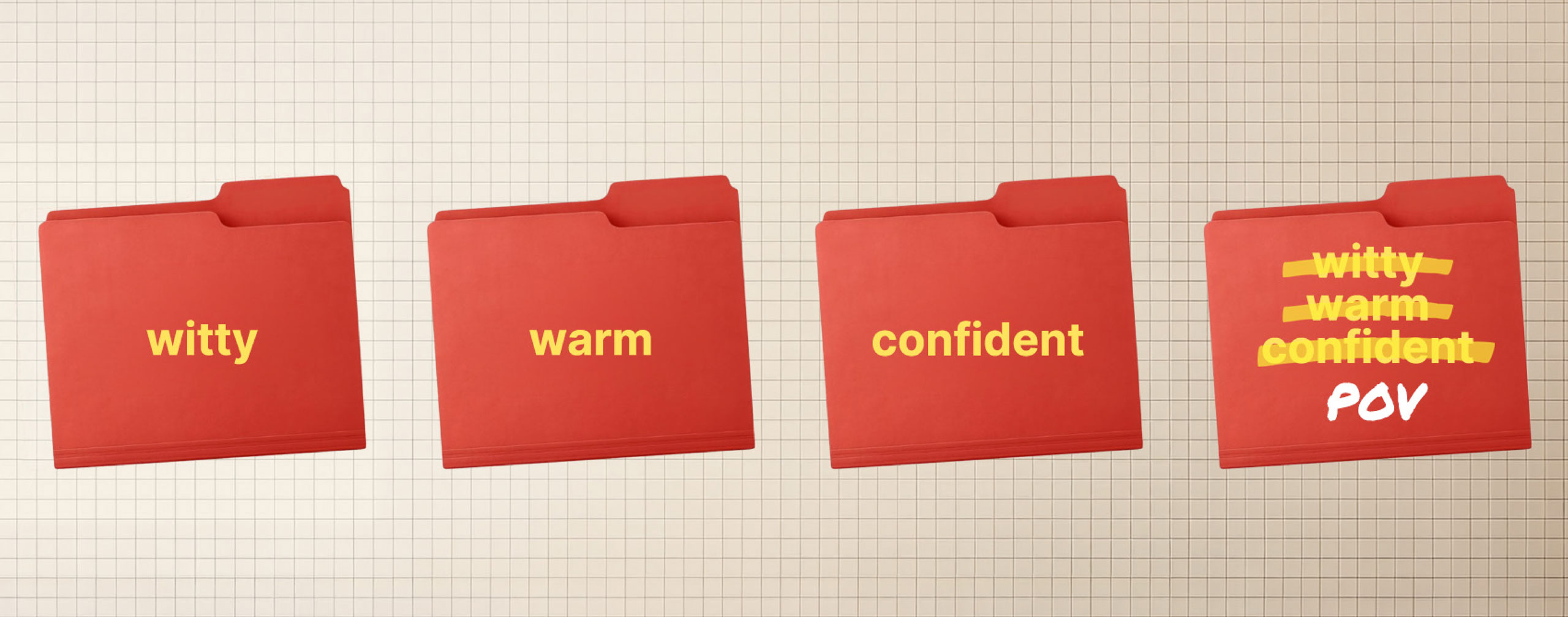
Somewhere over the past few years, the industry became obsessed with tone-of-voice documents. Whole workshops built around them Decks full of adjectives.
Brand personality sliders. “How we speak” sections. Guidelines about punctuation, contractions, emojis, sentence length, and whether the brand says “hey” or “hello.”
And to be fair, none of that is useless.
But most of it is cosmetic.
Because tone of voice is not the thing that makes content memorable. It’s not what makes people trust you. And it’s definitely not what makes a brand distinctive.
Tone is the surface.
Point of view is the structure underneath it.
You can rewrite your tone-of-voice document a thousand times. You can make it warmer, sharper, more human, more playful, more premium, more Gen Z, more “culturally relevant.” If there’s no conviction underneath it, the content will still feel hollow.
Because a voice without belief is just words.
And right now, a lot of brands sound polished while saying absolutely nothing.
What tone-of-voice documents actually are
Let’s be honest about what most tone-of-voice documents contain.
Usually, it’s some version of this:
Witty, but not trying too hard. Confident, but not arrogant. Human, warm, approachable. Smart, but accessible. Bold, but empathetic.
Then come the rules:
Use contractions. Keep sentences short. Avoid corporate language. Don’t overuse exclamation marks. Use an active voice. Prefer “we” over “the company.”
Words we say.
Words we never say.
Approved phrases.
Banned phrases.
Again, none of this is inherently bad. The problem is that none of it answers the only question that actually matters:
What does this brand believe about its category?
What do you think most competitors get wrong?
What frustrates it about the industry?
What hill is it willing to die on?
What does it value beyond sounding “on-brand”?
Because most tone-of-voice documents sound so generic that you could swap them between three competing brands and nobody would notice.
That’s the uncomfortable part.
The industry became obsessed with consistency. And forgot to be interesting.

Why brands ended up here
Because tone of voice is safe.
A POV isn’t.
A tone-of-voice document is a deliverable. It feels productive. It fits neatly into a strategy deck. And it can be approved without disagreement, because it rarely asks anyone to take an actual stance.
Nobody gets nervous approving the word “friendly.”
But a real point of view creates tension.
It forces decisions.
It means a brand has to believe something strongly enough to repeat it consistently. It means accepting that not everyone in the room will agree. It means saying something more specific than “we put customers first.”
And specificity makes people uncomfortable.
So instead, brands default to personality.
They build content strategies around sounding human rather than having perspective.
Which is why so much branded content today feels technically correct but emotionally empty.
The captions are polished.
The design is clean.
The copy sounds “on tone.”
And yet none of it leaves a mark.
The cost of voice without POV
This is where most content starts collapsing.
Not because the social team is bad.
Not because the writers lack creativity.
Not because the strategy is missing another workshop.
But because nobody decided what the brand actually stands for.
So social teams end up writing content that follows the guidelines while saying nothing interesting.
Brands tell creators and freelancers to “write in the brand voice,” but nothing underneath that voice gives them an anchor. So they mimic sentence structure.
They imitate the vocabulary . They recreate the tone. And the content still feels interchangeable.
Tone creates familiarity.
Conviction creates memorability.
Distinctive brands stand for something.
Hollow brands stand for nothing dressed in a personality.
And consumers are getting better at spotting the difference.
Research from Nielsen Norman Group found that trust explains 52% of the differences in brand desirability. Friendliness adds only 8% more. In other words: sounding nice matters far less than sounding believable.
That should force a lot of brands to rethink what they’re optimising for.
Because the obsession with being witty, warm, playful, or relatable often misses the point entirely.
People don’t recommend brands because they use contractions correctly.
They recommend brands that feel real.
And reality comes from having something to say.
Most brands are not as distinctive as they think they are
One of the biggest misconceptions in modern branding is that sounding slightly different equals being meaningfully different.
It usually doesn’t.
Research from the Ehrenberg-Bass Institute found that 77% of Apple users do not perceive Apple as unique. Even one of the world’s most dominant brands struggles to stand out clearly in consumers’ minds.
That matters because it exposes something the industry doesn’t like admitting:
Most brands wildly overestimate how distinctive they are.
A slightly different tone of voice does not suddenly create strategic separation.
A few playful captions do not build memorability.
A sharper brand personality does not automatically create emotional connection.
Repeated, recognisable belief actually creates distinctiveness.
A clear perspective.
A consistent way of interpreting the category.
A sense that this brand sees the world differently from everyone else in the room.
That’s what audiences remember.
Not adjective stacks.
What a real POV actually looks like
A point of view is not a positioning statement.
Positioning is what you sell.
POV is what you believe.
And the strongest brands usually have a clear belief system behind their content, whether they write it down or not.
A real POV sounds more like:
- Most brands overcomplicate this category. Luxury doesn’t have to mean exclusion. Customers don’t actually want more features, they want less friction.
Notice something important here:
None of these are necessarily controversial.
They’re just specific.
A real POV does not require outrage. It requires clarity.
It should feel like something you would defend in a room full of competitors.
It should shape not only what you say, but what you choose not to say.
And most importantly, it should make your content feel like it could only have come from you.
That’s the difference.
Tone of voice tells you how to say it.
Point of view decides whether it’s worth saying in the first place.
Emotion beats correctness
Another reason this matters: emotion outperforms neatness.
Nielsen research has consistently shown that emotionally driven advertising significantly outperforms purely rational messaging, often by nearly 2x in effectiveness.
And emotional resonance rarely comes from “tone.”
It comes from conviction.
From specificity.
From feeling a real human perspective in the content, not a brand trying to fake one.
People connect to brands that appear certain about something.
Not perfect.
Not polished.
Certain.
Which is also why tone without conviction eventually creates trust issues.
Qualtrics found that 65% of consumers have switched brand loyalty because the experience didn’t match the brand’s image or promises.
That gap matters.
Because once a brand starts sounding more thoughtful than it actually behaves, audiences notice.
And trust collapses fast when tone becomes performance instead of reflection.
The simplest test
Here’s the easiest way to know whether your brand has a real point of view.
Take your last three social posts.
Now cover the logo.
Could one of your competitors have posted them?
Honestly?
If the answer is yes, you probably have a voice.
But you don’t have a POV.
And no amount of rewriting the tone-of-voice guidelines is going to fix that.
The real work is deciding something
The brands doing the most memorable work right now are rarely the ones obsessing over sounding clever.
They’re the ones that have decided something.
About their customers.
About the industry.
About what good work looks like.
About what they refuse to participate in.
That clarity changes the content before you write a single caption.
Because once a brand genuinely believes something, the voice becomes easier.
More natural.
More recognisable.
More human, ironically, than all the brands trying desperately to sound human.
That’s the part most agencies skip because it’s harder than writing guidelines.
But it’s also the part that actually matters.
The work we’re proudest of has never come from clients asking us to make them sound different.
It comes from clients who already think differently.
To create content that sounds like you, first decide what you believe.
We’ll handle the rest.